Marine Search and Rescue
Learn more about how the SAR system works
OMSAR is a proud part of Canada’s Maritime Search and Rescue (SAR) system. Marine Search and Rescue comprises the search for, and provision of aid to, persons, ships or other craft which are, or are feared to be, in distress or imminent danger on the water. Western Lake Ontario is served by a network of organizations that work together with the common goal of saving lives,
Canadian Coast Guard
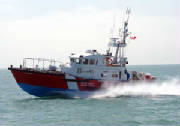
Part of the Department of Fisheries and Oceans, the Canadian Coast Guard is the principal civilian maritime operational arm of the Government of Canada. The Coast Guard is the provider of the primary maritime SAR response. The Canadian Coast Guard Search and Rescue vessel CCGC Cape Storm is currently assigned to the Coast Guard Station in Port Weller. The vessel is classed as a Multi-Task Medium Endurance Lifeboat. It is 47 feet in length with twin diesel engines, and can reach a speed of 25 knots for rapid deployment from home port to search and rescue areas. The vessel maintains a full crew complement and provides search and rescue coverage 24 hours per day, 7 days per week during the operational season. Cape Storm provides leadership during significant SAR incidents. Training, media events and boat shows also bring OMSAR and Cape Storm crews together several times each season.
Department of National Defense
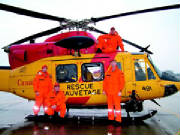
The Department of National Defense delivers primary air SAR services for both air and maritime incidents, and provides a high level of secondary SAR support from its aircraft. From its base at 8 Wing CFB Trenton, 424 (Tiger) Squadron provides SAR services to the Central and Arctic region, including Western Lake Ontario. To fulfill its roles,424 Squadron flies the CH-146 Griffon helicopterCH-146 Griffon helicopter and the Lockheed CC-130 HerculesLockheed CC-130 Hercules. They can search a large area in a short time dramatically speeding a search. They also carry SAR Techs who are highly trained specialists who provide on-scene medical attention and rescue for aviators, mariners and others in distress in remote or hard to reach areas. They are trained in advanced trauma life-support, land and sea survival, rescue techniques from helicopters, parachuting, diving, mountain climbing and rappelling. OMSAR practices deployment of SAR Techs from a helicopter to the Rescue Boat deck. In significant SAR incidents OMSAR participates in searches involving the CH-146 or CC-130 aircraft.

Joint Rescue Coordination Centre Trenton
The Joint Rescue Coordination Centre (JRCC) Trenton is responsible for the coordination of all SAR operations associated with aircraft and marine emergencies in the Central and Arctic Region which covers more than seven million square kilometres from the B.C. – Alberta border to the North Pole and Quebec City. Authority for the control of Search and Rescue is vested in the Minister of National Defence. The Canadian Coast Guard is responsible to provide personnel, equipment, and infrastructure to ensure marine SAR services are provided. The Search and Rescue Mission Coordinator (SMC) is the official temporarily assigned at JRCC to coordinate response to an actual or apparent distress situation. An On Scene Coordinator (OSC) may be designated by the SMC for local coordination of a specific search and rescue operation. All OMSAR SAR assignments (taskings) originate from JRCC. OMSAR reports to JRCC Trenton about the progress and outcome of taskings. OMSAR keeps JRCC Trenton informed about its operational status. OMSAR is available to JRCC Trenton 24/7 through a telephone and pager system.

Canadian Mission Control Centre
The Canadian Mission Control Centre (CMCC) for the COSPAS/SARSAT system is also located at CFB Trenton. COSPAS/SARSAT is the international satellite system for search and rescue. CMCCis Canada’s ground station for receiving distress signals picked up by satellite from Emergency Locator Transmitters (ELTs), Emergency Position Indicating Radio Beacons (EPIRBs) and Personal Locator Beacons (PLBs). If an aircraft, vessel or individual is in distress, the signal is picked up by an overhead satellite and then relayed to the CMCC and on to the appropriate Rescue Coordination Centre or, in the case of PLB activation, to provincial authorities. They also home to the Canadian Beacon Registry which maintains the database of system users for Canada.
Prescott Coast Guard Radio
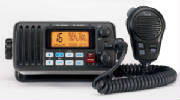
Prescott Marine Communications and Traffic Service provides distress and safety communications and coordination to detect distress situations, ensure timely assistance and savings of lives. They provide continuous monitoring of international distress and calling frequencies to detect distress situations and ensure speedy resolution of SAR incidents. Prescott Coast Guard Radio has a service area covering the upper St Laurence, the Canadian side of Lake Ontario, and Eastern Lake Erie. OMSAR is in regular daily contact with Prescott. Prescott is the VHF marine radio communications link for OMSAR to JRCC Trenton for instructions and reports regarding taskings. Monitoring Prescott on marine radio channel 16 alerts OMSAR to developing SAR situations.
Police and Fire Services
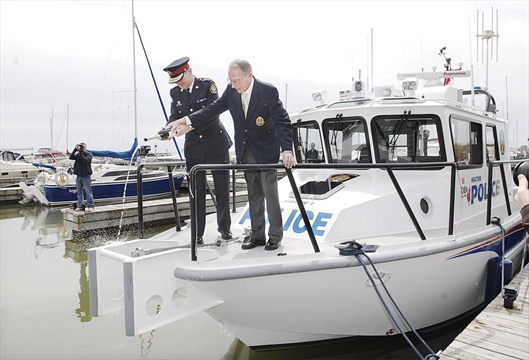
The Halton Regional Police Service (HRPS) Marine Unit provides year round law enforcement and search and rescue service to the waters of Lake Ontario including Oakville, Burlington. The unit also responds to inland reservoirs and creeks. The unit has a 39 ft Hike patrol vessel, 26 ft Boston Whaler patrol vessel, a 17ft patrol vessel. Marine unit officers are trained in a wide variety of skills. Officers patrol the waterfront to promote boating safety, enforce various laws relating to boating including the Canada Shipping Act, Liquor License Act, Criminal Code of Canada and local bylaws. The Unit takes an active role in providing SAR services. OMSAR works with the HRPS Marine Unit in both significant and more routine marine incidents. OMSAR and the Marine Unit have a mutual assistance plan and conduct joint training exercises. OMSAR reports its operational status to the HRPS dispatch and is available to them 24/7 via a telephone and pager system. OMSAR is also on call to the Oakville Fire Department dispatch. Use of the Town of Oakville trunked radio system allows communication from the Rescue Boat to OMSAR Headquarters. Other police marine units with jurisdictions in Western Lake Ontario are Hamilton Police Service, Peel Regional Police. Toronto Police Service and Niagara Regional Police Service Marine Units.
Canadian Coast Guard Auxiliary
The Canadian Coast Guard Auxiliary (CCGA) is an organization established by the Canadian Coast Guard in 1978. Our region is the Central and Arctic. Made up of dedicated volunteers who assist the Coast Guard in marine search and rescue operations and prevention, the Auxiliary enhances Canada’s SAR capability. CCGA vessels conduct over 1,800 rescue missions each year. They contribute to more than 25% of all marine call-outs in Canada and save an average of 200 lives each year. In Western Lake Ontario, in addition to OMSAR, there are a number of CCGA units including Hamilton Beach Rescue Unit (HBRU), Toronto Search and Rescue (T SAR), PARA Marine Search and Rescue (PARA), and GAMRU South Shore Search and Rescue. The numbers vary, but OMSAR annually responds to about 50 SAR taskings. While most taskings are for routine equipment or fuel problems, several each year involve lives being at risk.

National Search and Rescue Secretariat
The National Search and Rescue Secretariat (NSS) is responsible for managing and coordinating Canada’s search and rescue with federal, provincial and territorial partners, and fostering interoperability and coordination within the search and rescue (SAR) community and its 18,000 trained SAR volunteers. The Secretariat also focuses on national and international coordination, policy and program support, and helps facilitate multijurisdictional efforts in such areas as SAR incident prevention and response, distress alerting and interoperability, ensuring best use is made of SAR partners’ diverse resources and capabilities. It is responsible for the development and coordination of overall SAR policy in consultation with SAR partners, as well as supporting and promoting the activities of the National Search and Rescue Program (NSP) as a means to achieve highly effective and economically responsible SAR programs throughout Canada.